
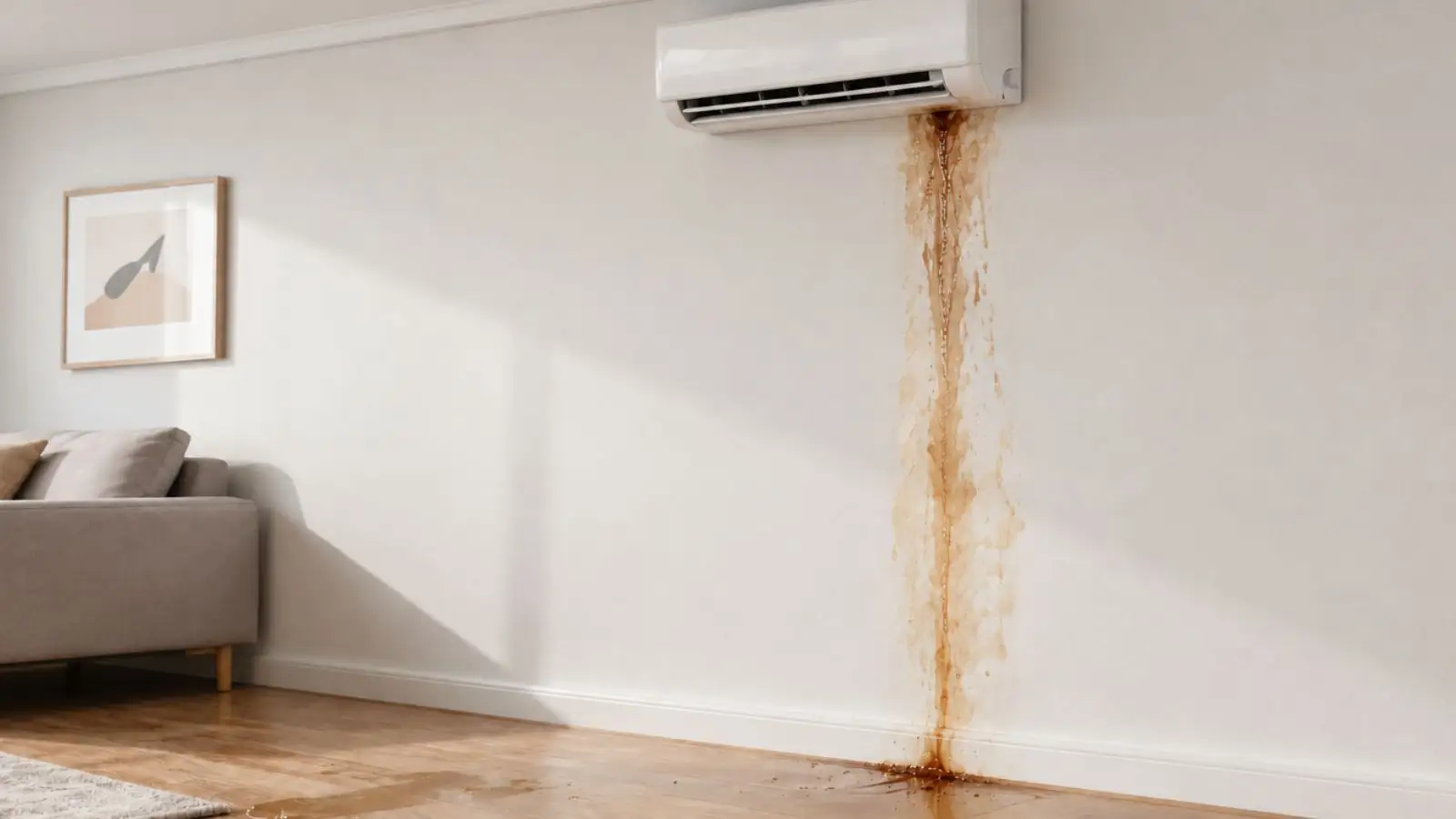
An air conditioner pulls moisture out of the air as it cools, and that water has to go somewhere. When the path out fails, the water ends up in a pan, on a ceiling, inside a wall or down a wall face.
We do not repair cooling equipment. A licensed HVAC contractor fixes the unit and the drain line, and we handle the wet structure. Dispatch answers 24 hours a day, and same-day response is offered when it is available.
How an AC Unit Ends Up Leaking Into the House
Cooling coils produce condensate, a steady trickle of water that normally runs into a pan and out through a drain line. If your system has an indoor coil, the common failure is a clogged condensate line. Algae and sludge build up in the pipe, the water backs up, and it spills over the pan.
If your home has an air handler in the attic or a closet, the overflow pan under it can fill and run over, or rust through and drip. If you have a ductless wall unit, a tilted unit or a blocked drain hose can send water down the wall instead of outside.
We have no verified local count of which systems Encinitas homes use, so we cover each case conditionally.
Found a brown ring on the ceiling under the air handler or a damp wall below a ductless unit? Describe it to dispatch and we will talk through what to do next.
☎ (760) 769-1159What You See and What It Usually Means
| What you see | What it often means |
|---|---|
| Brown or tan ring on a ceiling below an attic unit | Overflow or a rusted pan has been dripping through insulation and drywall |
| Damp carpet or baseboard near a closet air handler | The drain line is backing up, or the pan has spilled onto the floor |
| Water streaks or paint blisters under a ductless unit | The unit is tilted or its drain hose is blocked, so water runs down the wall |
| Rust-colored streaks on drywall | Water has crossed metal, such as a pan or a fastener, before reaching the surface |
| Sagging or soft ceiling drywall | Water has pooled above the board for some time and is soaking the insulation |
A slow leak is easy to miss. Mark the edge of a faint stain with a pencil and check it again after the system has run for a day or two.
First-Hour Safety Steps
Electrical risk comes first
Air handlers, ceiling lights and wiring often sit close together. If water is dripping near a light fixture, outlet, junction box or the unit's electrical connections, stay away and do not touch them. Call 911 or your electric utility before you call us.
Turn the system off at the thermostat first. Cut power at the breaker panel only if the panel is dry and you can reach it safely.
- Switch the thermostat to off so the unit stops making more condensate.
- Place a bucket under active drips, but stay clear of any bulging ceiling.
- Move furniture and electronics out of the wet area.
- Stay out of an attic with wet insulation near wiring.
- Photograph the stain, the unit and the pan before anything is changed.
- Call an HVAC contractor to stop the leak, then call us for the wet materials.
How We Dry and Repair the Damage
We start by confirming the leak is stopped, then measure how far the water spread. Moisture often travels beyond the visible stain.
- Measure the wet areaA moisture meter reads drywall, framing and subfloor, and a thermal camera shows cool, wet zones behind finished surfaces.
- Remove what cannot drySaturated insulation and sagging or crumbling drywall are cut out past the wet edge, back to dry, solid material.
- Dry the structureAir movers and dehumidifiers run until the readings match dry reference points. Our structural drying work follows the logic of ANSI/IICRC S500, the published standard for water damage restoration.
- RebuildNew insulation, drywall, taped seams, stain-blocking primer and paint bring the ceiling or wall back. Our water damage repair page explains how the rebuild is scoped.
What Changes the Cost
Cost follows the damage, not the type of cooling system.
- Water category. Condensate that sat in a dirty pan or an old line can be dirtier than clean supply water, and that changes what is removed.
- Affected area. One ceiling stain and a stretch of wet attic insulation across a hallway are different jobs.
- Materials involved. Drywall, blown-in insulation, flooring, trim and cabinets each have their own replacement needs.
- Drying days and equipment. Wet framing in a closed ceiling cavity takes more equipment time than a surface stain suggests.
- Rebuild scope. Patch and paint is smaller than replacing a ceiling section, insulation and finish.
Insurance: Sudden Leak or Slow Drip
The California Department of Insurance notes that homeowners policies typically exclude flood, which is a different thing from an air conditioner leak. For a leak from your own equipment, the question insurers ask is usually whether the damage was sudden and accidental or developed gradually. A pan that overflowed overnight and a drain line that has dripped for months can be treated very differently.
Sudden and accidental water damage is often covered, while gradual leaks and neglect often are not. Policies vary on whether they cover the repair of the unit itself, the water damage it caused, or both. Check your policy or ask your insurer how your loss is classified, and keep photos, the HVAC invoice and every receipt.
Hiring Help and Checking Permits
An HVAC contractor needs a California license for work of $500 or more in combined labor and material, according to the Contractors State License Board. The Board also caps a down payment at 10 percent or $1,000, whichever is less. Check any license at cslb.ca.gov or by calling 800-321-CSLB (2752), and confirm it covers the work you are hiring for.
If equipment is being replaced or ceilings are being rebuilt, ask the Encinitas Building Division whether the work needs a permit. It sits at 505 S. Vulcan Ave and can be reached at 760-633-2730. We also take calls from nearby towns, including Carlsbad and Solana Beach, where the local building office answers the same question.
Mistakes to Avoid and Simple Prevention
- Painting over a ceiling stain before the framing above it is dry.
- Leaving wet attic insulation because the ceiling below looks fine.
- Running the system again before the drain line is cleared.
Have your HVAC contractor check the condensate line and pan during routine service, and ask about a float switch that shuts the system off when the pan fills. Look at the ceiling under attic equipment at the start of each cooling season. If a stain stays damp or a musty smell lingers after drying, a mold remediation assessment may be a reasonable follow-up.
Frequently Asked Questions
Yes. Dispatch is open 24 hours a day, and we offer same-day response when it is available. We cannot promise an arrival time, because it depends on the schedule and where the crew is at that moment.
No. A licensed HVAC contractor repairs the unit, clears the drain line and replaces a rusted pan. We dry the structure and repair the drywall, insulation and finishes the water reached. Check any contractor's license at cslb.ca.gov.
Common causes are a unit that is not level, a blocked drain hose or a dirty coil. An HVAC technician can tell which one applies. If the wall behind is wet, tell us so we can check the framing.
Yes. Water can soak insulation above the board for a long time before a stain appears. A brown ring that grows after the system runs is a sign to have the ceiling checked.
It depends on the policy and on whether the leak was sudden or gradual. Sudden and accidental damage is often covered and gradual leaks often are not. Check your policy or ask your insurer, and keep photos and receipts.